

There’s a specific kind of 2 a.m. I’ve gotten to know well. Not the up-with-a-sick-kid kind, the other one, staring at the ceiling with the same question on a loop: what actually happens to my son if my husband and I aren’t here one day, or after we’re both gone? Not in a vague someday way. In a real, who-signs-what, who-pays-for-what, does-he-lose-his-benefits way.
I sat with that question longer than I want to admit before I actually did anything about it. Worrying about it in the dark doesn’t change anything. Sitting down and learning the real options does. So that’s what I did over the past few weeks, and I’m writing down everything I found because I know I’m not the only parent lying awake with this exact question, and because when I finally started looking, most of what I found wasn’t nearly as complicated or as expensive as I’d been dreading.
ABLE accounts: the part that surprised me most
I’d heard the term “ABLE account” tossed around in a Facebook group for years and never actually looked into it, mostly because I assumed it wouldn’t apply to us for some reason I never bothered to check. Here’s what it actually is: a tax-advantaged savings account for a person with a disability, and the money in it doesn’t count against the asset limits that would otherwise knock someone off SSI or Medicaid.
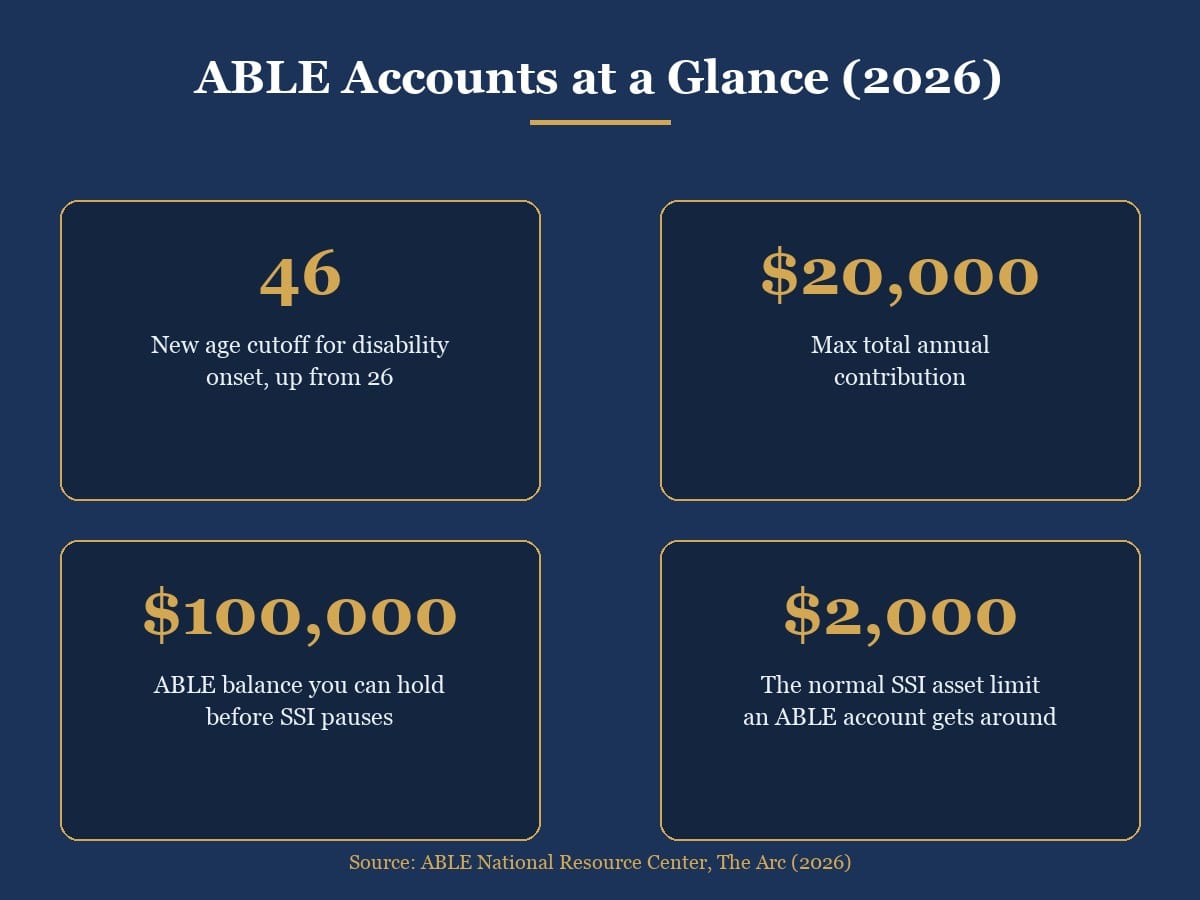
That last part is the whole point. Normally, SSI cuts you off if you have more than $2,000 in countable assets, which is a brutal number once you actually think about it. An ABLE account is built to get around that. Money saved in one doesn’t count toward that $2,000 limit, up to a $100,000 balance. Go over $100,000 and SSI payments pause until the balance drops back down, but in most states Medicaid coverage keeps going the whole time regardless of the balance, according to the ABLE National Resource Center.
The other thing I didn’t know: as of January 1, 2026, the eligibility rules changed in a big way. Before this year, your child’s disability had to have started before age 26 to qualify at all. The ABLE Age Adjustment Act pushed that cutoff to age 46, which according to reporting from The Arc opens up ABLE accounts to roughly 14 million more people nationwide, including about a million veterans. If you looked into this a few years ago and got a no, it might genuinely be worth checking again, because the answer may have changed even if nothing about your situation has.
Anyone can open an account and there’s no income limit to qualify. Anyone can put money into it too, not just the parents. Grandparents, aunts, uncles, family friends, whoever wants to contribute at a birthday instead of buying another toy that ends up in a bin. As of 2026, the annual contribution limit is $20,000 across all contributors combined, and if my son is ever working and doesn’t have an employer retirement plan, there’s an additional “ABLE to Work” allowance on top of that, roughly $15,060 in the continental U.S. (a bit higher in Alaska and Hawaii), capped at whatever he actually earns that year.
What you can actually spend it on
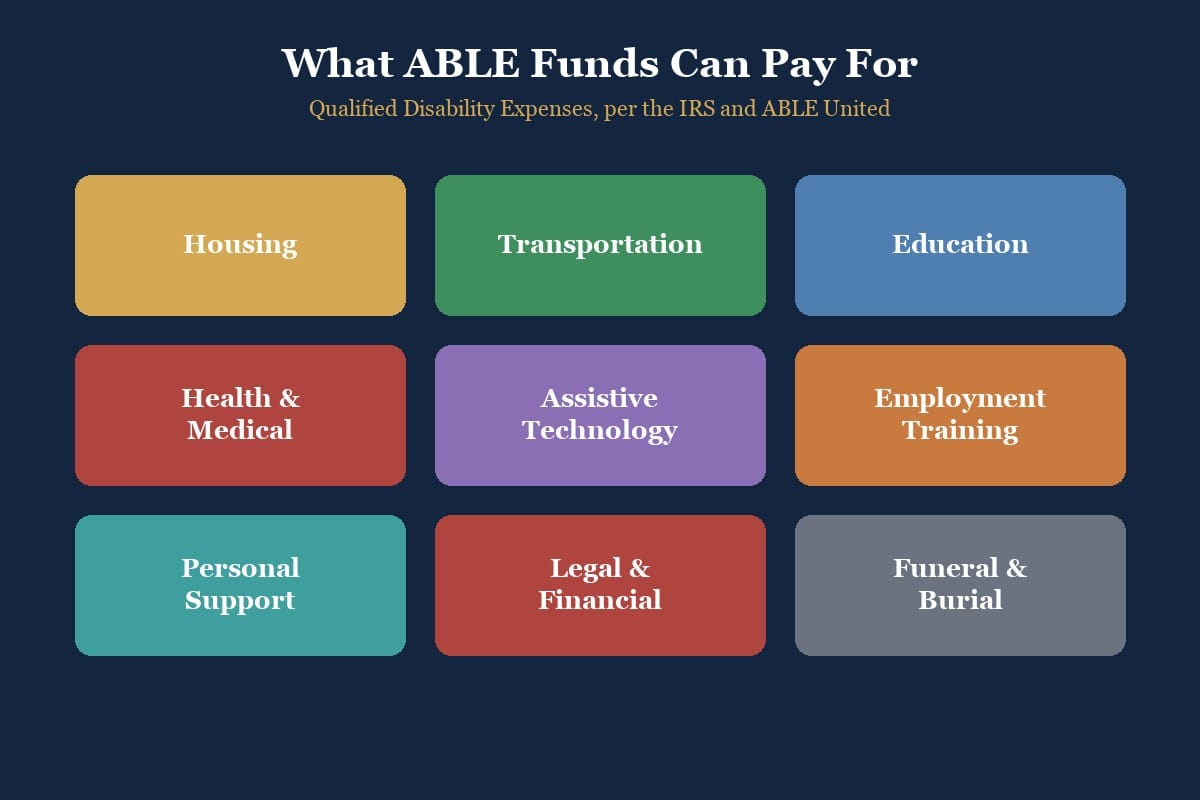
This was the question I actually cared about, because a savings account that only lets you save and never lets you use the money for anything real isn’t much of a plan. The IRS calls the allowed spending categories “Qualified Disability Expenses,” and the list is a lot broader than I expected. According to ABLE United’s own breakdown, qualified expenses include housing (rent, mortgage, utilities, home repairs), transportation (a car, gas, repairs, paratransit, rideshares), education from preschool through college, employment training and job supports, assistive technology and adaptive equipment, health and medical costs including insurance premiums, personal support services, legal and financial management fees, and even funeral and burial costs. A smartphone counts. A car counts. Basic living expenses count.
The one thing I’ll flag honestly: the IRS can ask for records on any of it, so keep your receipts. If money comes out for something that isn’t a qualified expense, you owe regular income tax on it plus a 10% penalty on the earnings portion. That’s not a reason to avoid using the account, it’s just a reason to keep a folder.
The 529 we already had
Here’s something that felt like it was written for exactly our situation. If you’re like a lot of parents I know and opened a 529 college savings plan for your child before the diagnosis, or before it was clear college in the traditional sense wasn’t going to be the path, you don’t have to leave that money sitting in a plan that no longer fits. Federal law allows a tax-free rollover from a 529 plan into an ABLE account, and as of this year that rollover option is permanent rather than set to expire, per coverage from Cerini & Associates. The rollover still counts toward that same $20,000 annual contribution limit, it isn’t extra room on top, so it’s worth planning the timing with whoever’s helping you rather than moving it all at once without checking first.
Our state’s program, and how to find yours
We’re in Florida, so our program is ABLE United. To qualify, you need to be a Florida resident with a disability that meets the eligibility rules above, and enrolling is honestly not the paperwork nightmare I braced myself for. There’s a short online eligibility quiz, and if you qualify, ABLE United says you can finish opening the account in about 15 minutes, no lawyer required, no minimum monthly contribution, no sign-up fees.
I know most of the people reading this aren’t in Florida, and I don’t want this to read like it only applies to us. Every state runs its own ABLE program, and most of them will accept you even if you don’t live there, 31 state plans as of 2026 according to the ABLE National Resource Center. Their state plan search tool lets you type in your own state and see what’s actually available, compare fees and investment options side by side, and find the enrollment link directly. Start there. Don’t assume your state doesn’t have one, and don’t assume you’re locked into your own state’s plan if a different one has better terms for your family.
Special needs trusts: the piece an ABLE account doesn’t cover
An ABLE account has that $20,000-a-year contribution ceiling, which is fine for day-to-day savings but nowhere near enough if you’re thinking about life insurance proceeds, an inheritance, or a house one day. That’s where a special needs trust comes in, and this is the part where I stopped trying to figure it out alone and actually called an estate attorney, because this is not a place to guess.

There are two kinds, and the difference matters a lot. A first-party special needs trust is funded with money that already belongs to your child, like a settlement or a direct inheritance left to them by name. The catch: it legally must include a Medicaid payback provision, meaning when your child passes away, whatever is left in the trust first goes to reimburse the state for Medicaid benefits paid over their lifetime, before anything can go to other family. A third-party special needs trust is funded with someone else’s money instead, most commonly built into a parent’s own will or life insurance policy. There’s no Medicaid payback requirement on a third-party trust at all. Whatever’s left stays with the family.
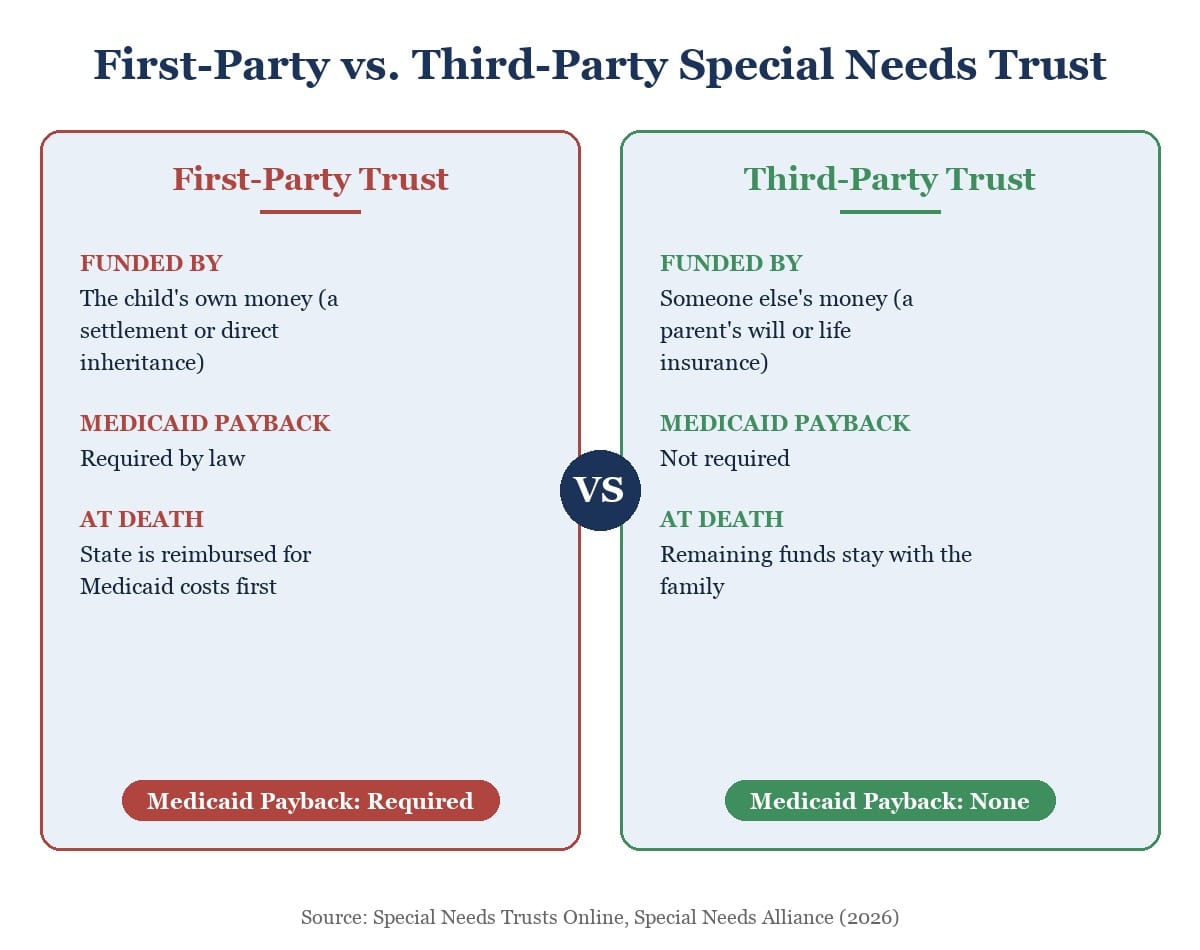
For us, that distinction settled the decision. If my husband and I are setting money aside through our own estate plan for our son’s future, a third-party trust is the vehicle that keeps it his without the state taking a cut at the end.

Who actually manages the trust
This was the question that stalled me the longest, because naming a trustee felt like naming who our son’s life depends on after we’re gone, and that’s a heavy thing to write down on a form. According to the Special Needs Alliance, a family member trustee usually knows your child’s real needs and preferences better than anyone, but may not be equipped to handle the legal and tax administration of a trust, and the stress of it can lead to burnout or honest mistakes, including well-meaning decisions that accidentally put benefits at risk. A professional trustee brings the technical skill and the objectivity, but doesn’t know your son’s favorite show or how he actually communicates when he’s overwhelmed.
The middle ground several sources pointed to, and the one our attorney suggested to us directly, is a co-trustee arrangement: a family member and a professional serving together, one bringing the personal knowledge and one bringing the administrative skill. There’s also the option of a pooled trust, where a nonprofit manages the funds of many beneficiaries together while keeping each family’s account separate, which can be a lower-cost option than a private professional trustee. We haven’t finalized this part yet. I’m telling you what we’re weighing, not what we’ve decided.
One more thing worth knowing, even though it isn’t settled yet: there’s a bill introduced in January 2026 called the Stop Unfair Medicaid Recoveries Act that would eliminate the federal requirement behind that first-party Medicaid payback provision entirely. It hasn’t passed. I’m not going to plan around a law that doesn’t exist yet, but it’s worth knowing it’s being discussed, in case it changes the calculation later.
What this doesn’t cover: guardianship
I want to be honest that everything above is about money, not decision-making authority. Who can legally make medical or educational decisions for my son once he’s an adult is a completely separate question from who inherits or manages his money, and it involves a different legal process entirely, guardianship or one of its alternatives. That’s genuinely a whole topic on its own, and not one I’m going to try to compress into a paragraph here and get wrong. I’m working on that piece separately, so consider this the financial half of a bigger picture, not the whole picture.
What We Talked About
Here’s what that actually turned into:
- Opened the ABLE United account. Fifteen minutes, no fees, done the same week we decided to stop putting it off.
- Set up small, automatic monthly contributions. Not a huge amount. Consistent beats impressive.
- Called an estate attorney who specializes in special needs planning, not a general estate lawyer, specifically one who does this kind of trust regularly.
- Started the third-party trust conversation, including who our co-trustees might realistically be.
- Put “guardianship research” on next month’s list instead of trying to solve everything in the same week.
I won’t pretend the trust part is finished, because it isn’t, and I don’t think it ever fully feels finished. But I sleep a little better now knowing there’s an actual plan taking shape instead of just a question I kept avoiding at 2 a.m.
If you’ve been carrying this same question, you don’t have to solve all of it in one weekend. Open the ABLE account first if you qualify. It’s the smallest, fastest step, and it’s real progress, not a placeholder for real progress. Then find a special needs planning attorney when you’re ready for the trust conversation. I know how heavy that first phone call feels. Make it anyway.
A Few of Our Go-To Favorites
Shop the Full StorefrontNothing in our storefront is specifically about financial planning, so here’s one real favorite from each of our other categories instead.

Trekassy 40" Saucer Tree Swing (Sensory Toys)
Our most-used backyard sensory swing, hands down.
$39.99

Skoolzy Peg Board Set (Sensory Learning Toys)
Great for fine motor practice, no screen required.
$16.99


MaryRuth’s Kids Ionic Zinc Drops (Suppliments)
Part of our everyday immune-support routine.
$18.95

Boon Travel Drying Rack (Travel Essential)
Small enough to actually pack, useful every trip.
$12.70

SwimWays Dive and Catch Game (ASD Swimming Gear)
Builds pool confidence without feeling like a lesson.
$19.43
If you’ve already been down this road and found something I didn’t mention here, I’d genuinely like to hear it. You can always reach me through the contact page.
Caren
Sources
- ABLE National Resource Center, general ABLE account rules, SSI/Medicaid interaction, and state-plan availability
- ABLE National Resource Center, “The ABLE Age Adjustment Act Fact Sheet”
- The Arc, “ABLE Accounts Expanded in 2026: New Eligibility Rules and How to Open One”
- ABLE United, Florida’s ABLE program, eligibility, enrollment, and qualified disability expenses
- ABLE National Resource Center, state plan search and comparison tool
- Cerini & Associates, on the permanent 529-to-ABLE rollover rule
- Special Needs Trusts Online, first-party vs. third-party trust Medicaid payback rules and the proposed Stop Unfair Medicaid Recoveries Act
- Special Needs Alliance, on choosing a family, professional, or co-trustee