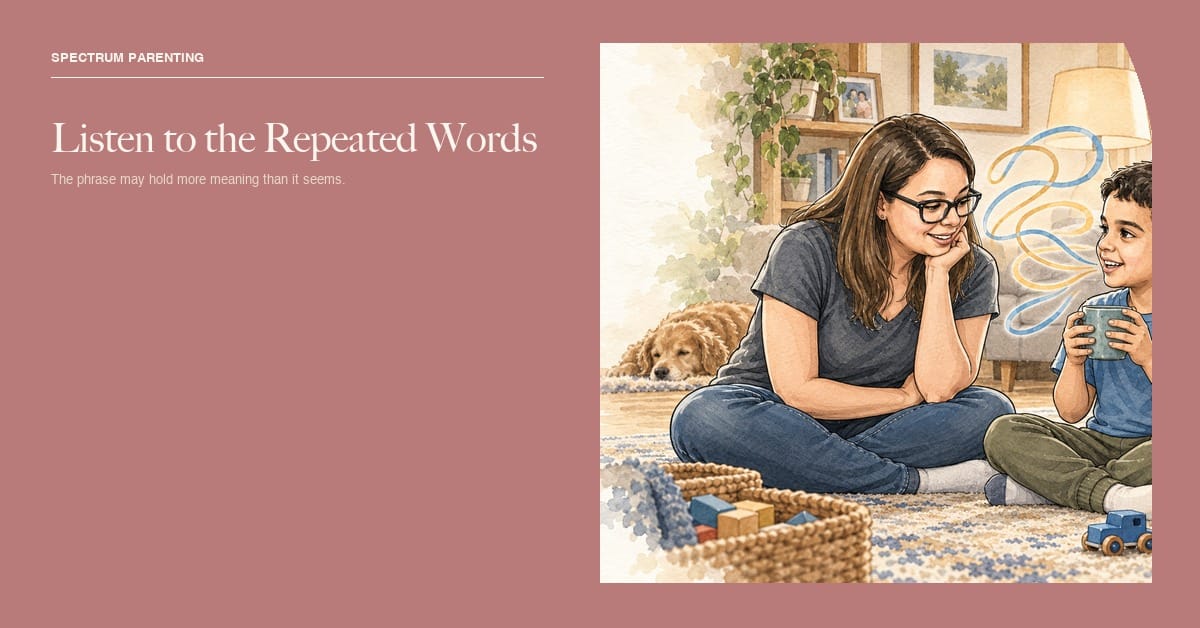
You ask, “Do you want a drink?” Your child says, “Do you want a drink?” back to you. Maybe they repeat it in the same sing-song voice. Maybe they say it while reaching for the cup. It would be easy to hear only the copy. I would want to look at the cup, too.
Repeating someone else’s words or phrases is called echolalia. A child may echo something right away, or bring back a phrase from a show, a book, or a conversation much later. The phrase may seem out of place to an adult who cannot see the connection. It can also be a way to ask, answer, protest, share excitement, process language, or manage a feeling. The American Speech-Language-Hearing Association (ASHA) says echolalia can serve meaningful communication, understanding, and emotional regulation. It should not automatically be discouraged.
I am careful here because an older article on this site described echolalia as repetition “without meaningful communication.” That phrase is too narrow. The evidence and the experiences of autistic people ask us to look for meaning before we decide there is none. That does not mean every repeated phrase has one obvious message, or that a parent must decode every line perfectly. It means we stay curious.
Listen to when the phrase happens

Immediate echolalia happens soon after the child hears the words. Delayed echolalia happens later. Those are descriptions of timing, not judgments about usefulness. ASHA’s autism practice guidance describes both and notes that a child’s repeated language may serve functions such as requesting, affirming, protesting, or keeping a conversational turn.
Go back to the cup. A child who repeats “Do you want a drink?” while reaching toward it may be saying yes with the words available to them. If an adult asks a complicated question and the child echoes the last part, the child may still be working out what was asked. If a line from a favorite show comes out as the room gets loud, it may be tied to comfort or regulation. These are possibilities, not translations that apply to every child. Watch what happens before and after, and ask the child when they can tell you.
The same phrase can do different jobs on different days. Tone, gesture, the person present, and the child’s body language all matter. A sentence that sounds like a movie quote to you might be a perfectly effective way to say “I want to leave” to someone who knows the scene. If no one understands it yet, that is a reason to learn the context, not a reason to call the speech meaningless.
I would keep a few notes for a week if a repeated phrase keeps coming up. Write the exact words, when they appeared, what happened just before, and what the child did next. Did the phrase happen near a snack, at pickup, or when a task changed? Did someone respond in a way the child seemed to appreciate? Those observations can help a speech-language pathologist see the child’s communication in real settings. ASHA recommends language sampling and looking at the function of echolalia as part of a thorough assessment.
Try to notice who understands the phrase already. A sibling, teacher, or caregiver may have seen it used many times and know the connection you are missing. Ask them what they observed instead of asking only what they think the child “meant.” Keep the child’s privacy in mind if you share videos or exact quotes. A private note for a clinician can be useful without turning every moment of communication into something posted for strangers to analyze.
Respond to the possible message, then offer another way
If a child echoes a question while pointing to a drink, you can respond to the likely request: “You want water. Here is water.” That gives the child a useful phrase without demanding they repeat it on command. If you are unsure, offer a real choice: “Water or juice?” and show the options. A gesture, picture, device selection, or word can all count as an answer.
If the child repeats a phrase during distress, start with the situation. Is the room loud? Is someone touching them? Did a plan change? Lower the demand and make room for the child to communicate. A phrase that calms them does not need to be taken away simply because adults hear it often. If they are trying to tell you something urgent, help them find a clearer signal that others will understand as well.
For repeated questions, there may be a need for predictability. A child who asks “Are we going now?” again and again might need a more concrete answer than “soon.” A picture schedule, a visible timer when time is truly known, or “after we put on shoes” may help. It may not stop the repetition immediately. The point is to give the child usable information, not to win a contest over how many times a question is asked.
Sometimes the most useful response is to join the connection. If a child quotes a character while playing, you might answer in the same play theme and see whether they invite you further. You can model a short, flexible line alongside the familiar phrase. This is different from forcing a child to abandon a script before they have another way to express the idea.
This does not require pretending you know the source of every line. You can say, “I hear that phrase. Are you telling me about the show, or do you need something?” Then pause. The child may answer with a look, a gesture, another line, or no answer yet. If the phrase seems to be working as conversation, respond to the conversation. If it seems to help the child regulate, give them space to use it. You can model another phrase without making the original one wrong.
What about “gestalt language processing”?
You may hear that a child who repeats scripts is a “gestalt language processor,” or GLP. Some clinicians use that description to talk about children who learn and use longer chunks of language. Families may find parts of that framework helpful. The trouble comes when a label is treated as a confirmed explanation for every child who echoes, or when a set sequence of stages is presented as settled science.
ASHA’s practice portal says clinicians can consider the theory while assessing language, but cautions against overgeneralizing it to all autistic language development. A recent ASHA journal discussion argues that specific stage-based Natural Language Acquisition recommendations still lack supporting evidence. A 2025 scoping review also describes disagreement in research on interventions aimed at echolalia. These are live professional discussions, not a reason to dismiss a child’s real communication.
If someone recommends a program because your child “is a GLP,” I would ask what they observed in your child’s everyday communication, what goal the child and family want, how progress will be measured, and what evidence supports the specific method. A useful clinician should be able to explain the plan without requiring you to accept a social-media slogan as a diagnosis.
This is where the child’s own preferences matter. A goal such as asking for a break, sharing a joke, or telling someone that a sound hurts has an everyday purpose. A goal framed only as reducing repeated speech may miss what the child was using that speech to do. Ask how a recommended approach will increase the child’s options and whether the child seems more understood. If a strategy makes the child quieter but less able to communicate, that deserves a new conversation with the clinician.
When to ask for more help
Ask a speech-language pathologist for an assessment if your child is having trouble making needs understood, seems frustrated by communication, or you want help understanding a pattern. Bring the phrases and contexts you have noticed. Ask the clinician to observe play and ordinary interaction, not only responses to test questions. If the child uses an AAC device, pictures, sign, or gestures, those belong in the assessment too. Spoken words are only one part of communication.
Tell the child’s health professional about a sudden loss of language or a marked change in communication, especially if it comes with other new symptoms. That calls for an individual evaluation. A general explanation of echolalia cannot sort out a new medical or developmental concern on its own.
I do not want a child to learn that adults listen only when the words sound original. A borrowed phrase can still be a child’s chosen phrase in that moment. We can answer what we understand, ask when we do not, and keep giving the child more ways to be heard. The goal is connection and clearer communication, not a ban on repeating.
If you take one thing into the next conversation with your child, let it be a little more time to listen before correcting the words. That pause may tell you more than another prompt to “say it properly.”
Caren
A Few of Our Go-To Favorites
Shop the Full StorefrontThese storefront picks cover other parts of family life; none is a treatment for the topic in this article. Check Amazon for current prices and availability.

Trekassy 40 inch Saucer Tree Swing (Sensory Toys)
From Caren’s storefront collection.
See current price

Skoolzy Peg Board Set (Sensory Learning Toys)
From Caren’s storefront collection.
See current price
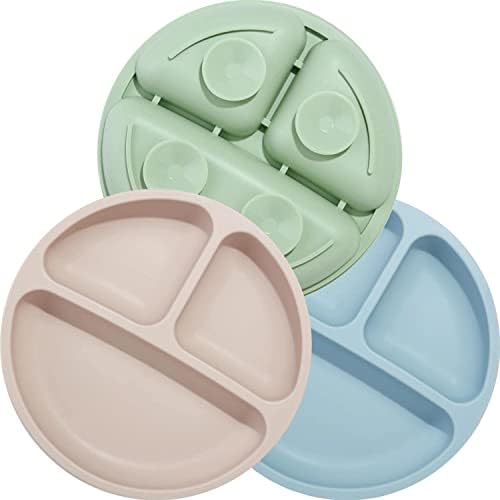
PandaEar Divided Suction Plates (Feeding Tools)
From Caren’s storefront collection.
See current price

MaryRuth's Kids Ionic Zinc Drops (Suppliments)
From Caren’s storefront collection.
See current price

Boon Travel Drying Rack (Travel Essential)
From Caren’s storefront collection.
See current price

SwimWays Dive and Catch Game (ASD Swimming Gear)
From Caren’s storefront collection.
See current price
Sources
- American Speech-Language-Hearing Association, Autism and Communication Skills: Addressing Misconceptions With Scientific Facts
- American Speech-Language-Hearing Association, Autism and Autism Spectrum Disorder Practice Portal
- American Journal of Speech-Language Pathology, Intervention Techniques Targeting Echolalia: A Scoping Review
- Perspectives of the ASHA Special Interest Groups, A Response to Blanc and Colleagues’ Viewpoint