
My son is eight. Right now, school is a place with a schedule, a team, and a legal process for discussing support. High-school graduation feels far away. Still, I kept seeing parents use the same phrase for what can happen afterward: the services cliff.
The phrase describes a real change in systems. School-based special education is an entitlement for eligible students under IDEA. Adult programs often have separate applications, eligibility rules, funding limits, and waiting lists. A diploma or final school year can arrive on a fixed date even when the next support does not.
I have not taken my son through this transition, so I am not writing from the other side of it. I am writing as a parent who wants to know which questions belong on the calendar long before the last day of school.
Understand which system is ending
IDEA defines transition services as a coordinated set of activities designed around a student’s needs, strengths, preferences, and interests. The possible destinations include further education, vocational education, employment, adult services, independent living, and community participation.
Federal rules require transition content in the IEP no later than the first IEP in effect when the student turns sixteen, or younger when the team finds that appropriate. Some states begin earlier. School eligibility can continue beyond age eighteen for some students, but the ending age and diploma rules vary. Ask the district and state education agency what ends eligibility in your state instead of relying on another family’s timeline.
Adult systems do not simply inherit the IEP. The document can provide valuable history, but Medicaid waiver services, vocational rehabilitation, Social Security, college disability services, developmental-disability programs, and housing supports each have their own doors.
Put the student’s life at the center
A transition plan should begin with a life, not a list of agencies. What does the student want more of? What kind of work, learning, community, home, relationships, and daily rhythm make sense? How do they communicate preference or refusal? Which environments help them participate?
The U.S. Department of Education’s 2025 transition guidance says postsecondary goals should be measurable and based on age-appropriate transition assessment. It also explains that the student must be invited when the IEP meeting will discuss postsecondary goals and transition services.
- Ask what assessment identified the student’s interests, strengths, and support needs.
- Connect annual IEP goals to an adult-life outcome the student values.
- Include communication, self-advocacy, travel, daily living, and community access when relevant.
- Ask who is responsible for each activity and when it will happen.
- Review the plan every year instead of copying last year’s transition page.
Open adult-service doors before school closes
Ask the school which adult agencies can be invited to the IEP meeting. With the required consent, IDEA rules allow representatives of agencies likely to provide or pay for transition services to participate. An invitation does not guarantee eligibility or funding, but it can turn “contact them later” into a named next step.
State vocational rehabilitation agencies may provide pre-employment transition services and, for eligible individuals, individualized vocational services. The Department of Education’s transition guide for students and youth with disabilities explains how IDEA and vocational rehabilitation responsibilities can meet. Ask when a student can apply, who obtains consent, and what documentation the agency needs.
For developmental-disability and home- and community-based services, start with the state agency and Medicaid office. Services and waiver names differ. Financial and functional eligibility may be separate, and a waiting list may not begin until an application is complete. Ask for written confirmation of application status and what must be updated each year.
Build one transition binder
Paperwork gets scattered across school, clinics, benefit offices, and provider portals. Keep one secure record with a simple index. Include current evaluations, IEPs, progress data, communication information, medication and health summaries, identification documents, benefit notices, agency applications, contact names, and consent or decision-support documents.
Add a page for deadlines. Record the date submitted, confirmation number, missing document, next follow-up date, and person contacted. A vague instruction to “call adult services” is not a plan. A dated application with a receipt and a follow-up name is something a family can track.
Plan across five connected areas
Education and training: Ask whether the goal is college, a certificate, adult education, job training, or continued school services. College disability offices do not create IEPs. Students generally must disclose a disability and request accommodations through that institution’s process.
Employment: Build experiences before exit when possible. That may include job exploration, workplace readiness, work-based learning, self-advocacy instruction, or vocational rehabilitation services. Ask how support needs will be documented in real settings, not only discussed in a classroom.
Health care: Ask pediatric providers when they transition patients, which adult clinicians accept the insurance, how records will move, and how the young adult will participate in decisions. Do not wait until a prescription or specialist relationship is about to end.
Daily life and community: Practice the actual routines needed for the person’s goals. Transportation, communication with unfamiliar adults, meal preparation, money safety, scheduling, recreation, and asking for help may need direct teaching or ongoing support.
Benefits and legal authority: SSI disability eligibility is reviewed under adult rules at eighteen for recipients who qualified as children. Education rights may transfer under state law. Guardianship is only one possible legal tool. Treat each process separately and get state-specific advice.
Make a backup plan for gaps
Ask what happens if the preferred program has no opening on graduation day. Can school eligibility continue? Is there a temporary day, employment, respite, or community option? Which supports can be provided at home? What transportation is available? Who will stay in contact with the family while they wait?
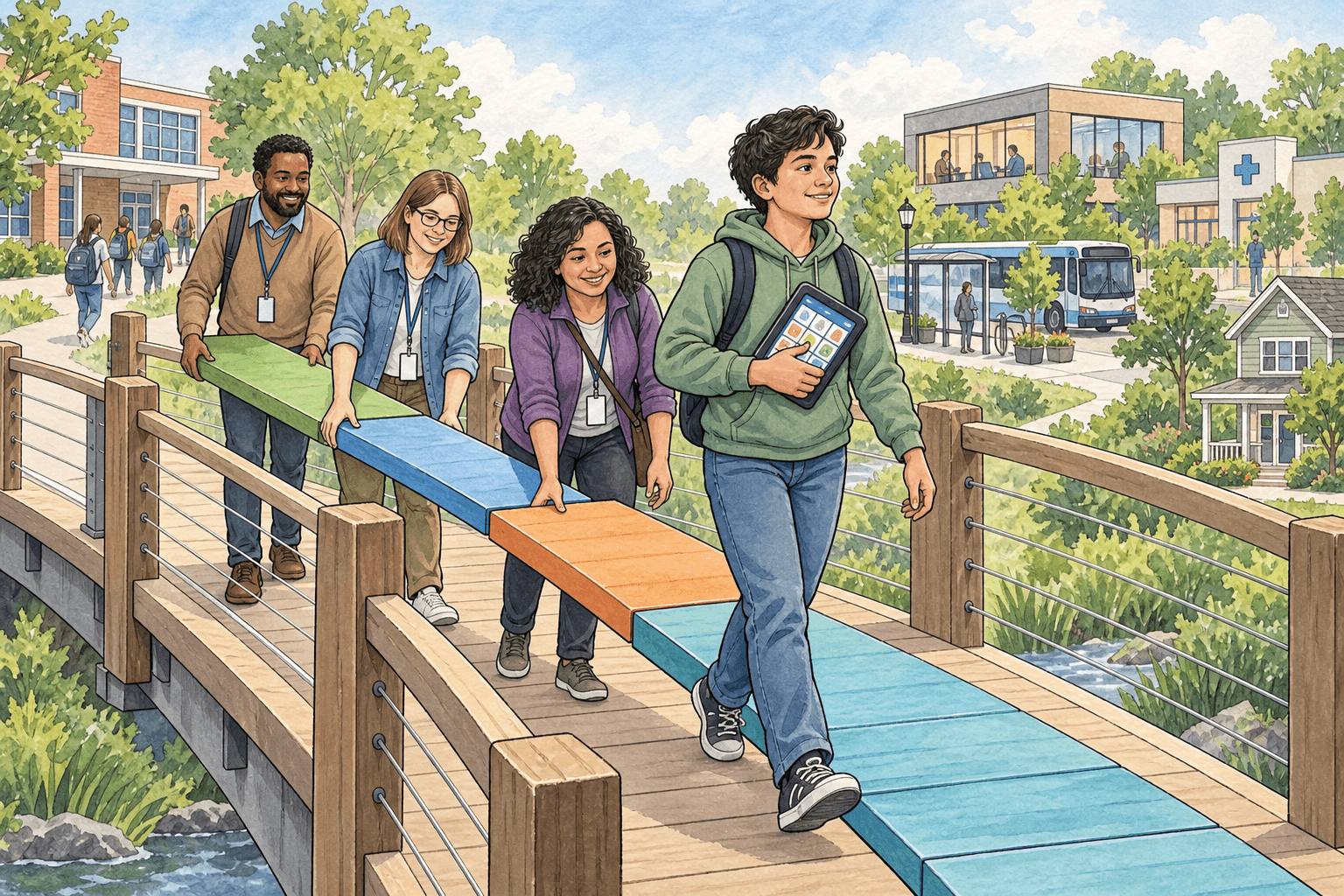
Families should not have to build the entire bridge alone, but pretending there will be no gap does not protect anyone. Put the concern into the IEP meeting notes. Ask agencies for written answers. Keep applying while the school team is still available to share records and coordinate.
Use a rolling timeline instead of one graduation deadline
Several years before exit, ask when federal and state transition requirements begin, which assessments the school uses, and how the student will participate. Begin a list of adult agencies and eligibility ages. Practice choices and community routines tied to the student’s goals.
About two years before the expected exit, review applications, waiting lists, health-care transfer, transportation, benefits, legal decision support, and documentation. Ask each agency how early it accepts an application. “Come back after graduation” should include a date, eligibility rule, and contact name.
During the final school year, confirm the actual exit date and diploma or certificate effect under state rules. Get current evaluations and a summary of performance where applicable. Confirm who will provide each support the week after school ends, not only the long-term goal.
After exit, keep following up. An approval letter may still require choosing a provider, arranging transportation, completing intake, or waiting for staffing. Record gaps and ask the responsible agency for written next steps. Transition continues after the ceremony.
Start earlier than feels necessary
Early planning does not mean choosing an eight-year-old’s career or living arrangement. It means noticing preferences, teaching choices, saving records, and learning which agencies exist. The plan should change as the child grows.
I do not know exactly what adulthood will look like for my son. I do know I would rather meet these systems one at a time than discover all of them during the final semester of school.
Put one question on the calendar this month. Find the transition contact. Ask when planning begins in your state. Save the answer where the next school team can find it. A bridge built early can still be changed, but at least the first board is down.
A Few of Our Go-To Favorites
Shop the Full StorefrontNothing in our storefront is specific to this guide, so here’s one real favorite from each of our categories instead.

Trekassy 40" Saucer Tree Swing (Sensory Toys)
Our most-used backyard sensory swing, hands down.
$39.99

Skoolzy Peg Board Set (Sensory Learning Toys)
Great for fine motor practice, no screen required.
$16.99


MaryRuth’s Kids Ionic Zinc Drops (Suppliments)
Part of our everyday immune-support routine.
$18.95

Boon Travel Drying Rack (Travel Essential)
Small enough to actually pack, useful every trip.
$12.70

SwimWays Dive and Catch Game (ASD Swimming Gear)
Builds pool confidence without feeling like a lesson.
$19.43
If you’ve already been down this road and found something I didn’t mention here, I’d genuinely like to hear it. You can always reach me through the contact page.
Caren
Sources
- U.S. Department of Education, IDEA definition of transition services
- U.S. Department of Education, Coordinating Transition Services and Postsecondary Access
- U.S. Department of Education, A Transition Guide to Postsecondary Education and Employment
- Social Security Administration, Understanding SSI Redeterminations