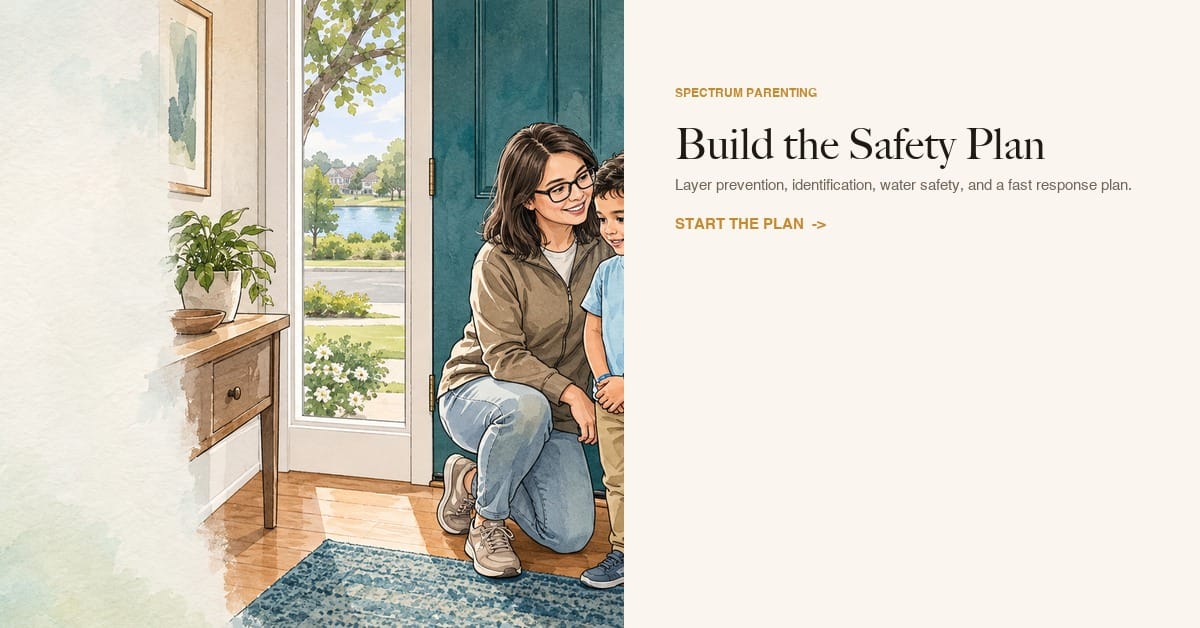
The front door opens while groceries are coming inside. A child sees the pond across the street, or hears a favorite truck, or needs to get away from a room that suddenly feels too loud. By the time an adult turns around, the doorway is empty.
Wandering, sometimes called elopement, can happen quickly even in a caring, attentive family. Shame wastes time. A useful safety plan accepts that one lock, one alarm, one lesson, or one adult cannot carry the whole job. Layers matter.
The CDC defines wandering as leaving a safe area or responsible caregiver in a way that may lead to harm. Children may be trying to reach water or another favorite place, explore, follow something interesting, or escape noise, stress, and demands. Understanding the reason helps with prevention, but the immediate risk still needs a concrete plan.
Start with the places that fail
Walk through an ordinary day. Check the front door during grocery unloading, the garage when someone leaves for work, the backyard gate, bathroom exits, school arrival, recess, dismissal, the bus, grandparents’ homes, hotels, playgrounds, and crowded events. Notice moments when supervision changes hands. “I thought you had him” is a system gap, not a character flaw.
Write down what tends to happen first. Does the child look at a door, remove shoes, repeat a place name, cover their ears, pace faster, or pull toward water? Does wandering happen during transitions, after a demand, while waiting, or when a favorite destination is nearby? Those early signs can trigger support before the child reaches an exit.
Layer the home protections
- Use door and window alarms that adults can hear throughout the home.
- Place child-resistant locks or latches where they meet local fire and building safety rules.
- Secure pools with appropriate barriers and self-closing, self-latching gates.
- Keep keys and garage remotes out of reach if the child uses them to leave.
- Add a visual stop cue only as a reminder, never as the only protection.
- Test alarms and replace batteries on a written schedule.
Locks must not create a fire trap. Ask the local fire department or building authority how to secure exits while preserving emergency escape. Every caregiver needs to know how the system works, including babysitters and visiting relatives. A clever device that only one adult can operate is not a dependable layer.
Build the emergency sheet before you need it
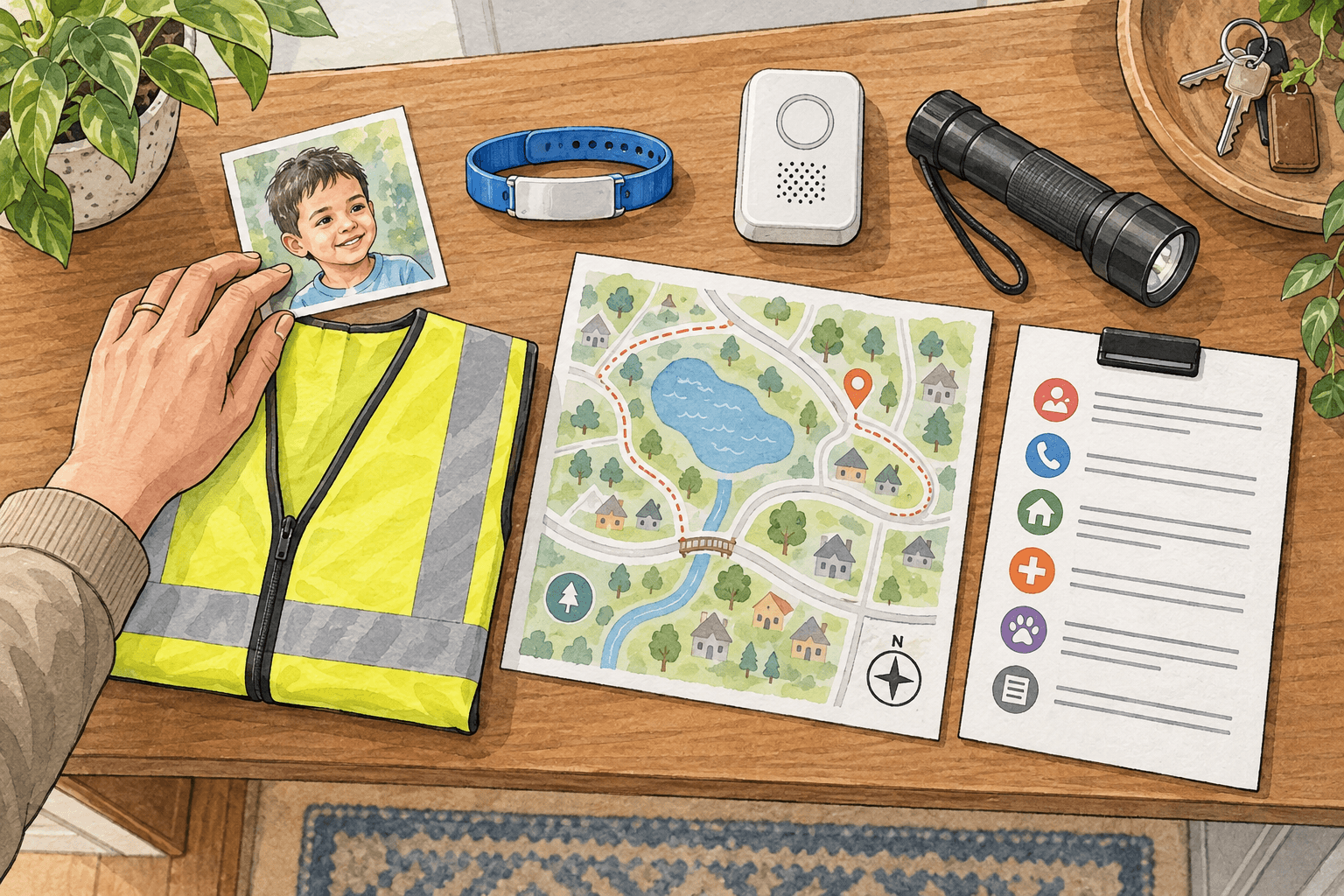
Prepare a one-page sheet with a recent clear photo, full name, physical description, communication method, sensory needs, medical concerns, likely destinations, attraction to water or traffic, and ways to approach without increasing fear. Include caregiver contacts and any tracking-device information. Keep printed copies near an exit, in vehicles, and with the school plan. Update the photo and details regularly.
Tell trusted neighbors what wandering looks like for this child and how to contact you. Share only what is needed for safety. A child’s entire diagnosis history does not belong in a neighborhood message. A photo, likely destination, communication note, and phone number may be enough.
If a child is missing, call now
Call 911 immediately. Do not spend the first twenty minutes searching alone because you are worried about overreacting. Say that a child with a disability is missing, share the child’s description and communication needs, and identify nearby water, roads, train tracks, traffic signals, enclosed spaces, and favorite places.
The National Center for Missing & Exploited Children tells families and first responders that children who wander may head toward water, roads, vehicles, or special interests and may hide from loud searchers. Its public safety campaign emphasizes searching water first when an autistic child is missing. Give responders the emergency sheet and explain whether sirens, shouting, touch, or uniforms may cause the child to hide or run again.
One adult should stay at the place the child left in case they return. Another can provide responders with information. Do not send untrained children into water, traffic, construction areas, or woods to search. Follow emergency personnel instructions.
Teach safety in very small pieces
“Be safe” is too broad. Practice one action in the real place where it matters: stop at the yellow line, touch the wall beside the front door, wait for an adult hand at the parking lot, show the ID card, or move toward a familiar helper. Use the child’s strongest communication method.
- Practice when the child is calm and the setting is quiet.
- Use one short cue and one visible boundary.
- Reward the safe action immediately with something meaningful to that child.
- Repeat in several real settings with close adult support.
- Keep the physical safety layers in place even when practice is going well.
Swimming lessons are a valuable layer for many children, especially when water is a strong interest. They do not make unsupervised water safe. Keep barriers, alarms, close supervision, life jackets where appropriate, and the emergency plan.
Identification and location technology
An ID bracelet, shoe tag, clothing label, or communication card can help someone reunite a child with family. Choose something the child can tolerate and check that the contact information is current. If a child removes wearable identification, consider more than one placement.
GPS and other location devices can add information, but they have limits. Batteries die. Coverage drops. A child may remove the device. Location can lag, and private data can be stored by a company. Ask how often the device updates, where it works, who can see the data, how it is secured, what the monthly cost is, and how to delete the account. Never let a tracker replace supervision, barriers, or an emergency call.
Put the same plan into school and community settings
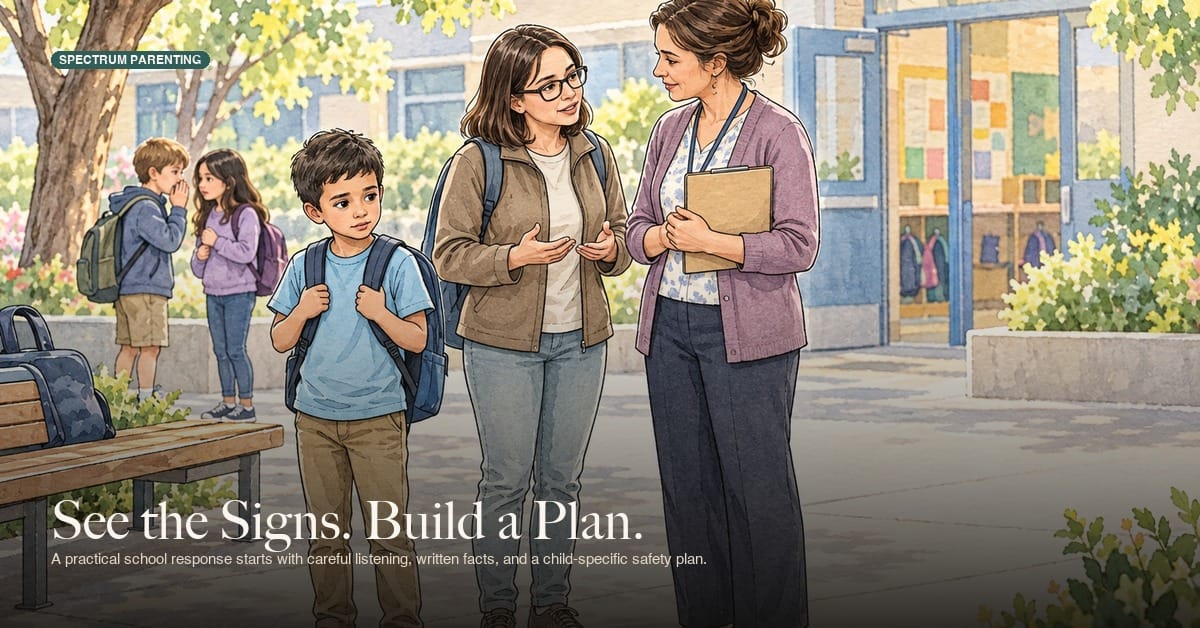
A school plan should name the high-risk times, exact adults responsible, supervision handoffs, exits, response steps, and how the family is contacted. Ask what happens during recess, arrival, dismissal, fire drills, field trips, substitute-teacher days, and transportation. “Close supervision” needs a shared meaning.
If wandering is connected to overload, communication, or escaping a task, the team also needs to reduce the trigger and teach a safer way to ask for a break. Security without communication can stop one exit while leaving the child in the same distress. A functional behavior assessment may help the team understand patterns, but immediate safety measures should not wait for a lengthy process.
Plan for travel and other caregivers
A hotel door, rental house, airport, family party, or unfamiliar playground removes the protections everyone knows at home. Before arrival, identify exits, water, roads, elevators, stairwells, and places that match the child’s interests. Bring portable door alarms when lawful and appropriate, the current emergency sheet, identification, a recent photo, and familiar communication supports.
Assign supervision with words. “Maria has eyes on him from the car until we are inside” works better than assuming the closest adult is watching. Say when responsibility begins and ends. At a pool, the designated water watcher should not be cooking, reading, drinking alcohol, or checking a phone. Change watchers with a direct handoff.
Give babysitters and relatives a short practice before leaving them responsible. Show every lock and alarm, demonstrate the child’s help signal, name likely destinations, and explain that they should call 911 immediately if the child is missing. Leave written information where it can be found under stress. A verbal explanation given while everyone is putting on shoes will not be enough.
Review every incident without blame
After everyone is safe, record where the child left, the time, who believed they were supervising, which alert worked or failed, where the child went, and what may have drawn or pushed them. Change the system. Move an alarm, repair a latch, clarify a school handoff, add a visual exit routine, or address the noise that preceded the run.
Do not make the child listen to adults replay panic and blame. They may already be overwhelmed. Teach the next small safety action when calm, and give caregivers room to process what happened away from the child.
A strong plan does not depend on perfect vigilance. It expects busy hands, open doors, substitute teachers, dead batteries, and crowded places. Put several protections between one ordinary mistake and a dangerous outcome.
A Few of Our Go-To Favorites
Shop the Full StorefrontNothing in our storefront is specific to this guide, so here’s one real favorite from each of our categories instead.

Trekassy 40" Saucer Tree Swing (Sensory Toys)
Our most-used backyard sensory swing, hands down.
$39.99

Skoolzy Peg Board Set (Sensory Learning Toys)
Great for fine motor practice, no screen required.
$16.99


MaryRuth’s Kids Ionic Zinc Drops (Suppliments)
Part of our everyday immune-support routine.
$18.95

Boon Travel Drying Rack (Travel Essential)
Small enough to actually pack, useful every trip.
$12.70

SwimWays Dive and Catch Game (ASD Swimming Gear)
Builds pool confidence without feeling like a lesson.
$19.43
If you’ve already been down this road and found something I didn’t mention here, I’d genuinely like to hear it. You can always reach me through the contact page.
Caren