I have used “child with autism,” “autistic child,” “on the spectrum,” and ASD. Then I learned that the wording professionals once taught as automatically respectful is not the wording every autistic person prefers.
That does not mean parents need to panic over every sentence. It means we should understand why the words matter, listen to autistic people, and stop treating one rule as universal.
The two common forms
Person-first language places the person before the diagnosis: “person with autism.” It grew from an effort to remind institutions that a disability does not erase someone’s humanity. Many medical, education, and government documents still use it.
Identity-first language says “autistic person.” Many autistic people explain that autism shapes perception, communication, sensory experience, and identity, so it is not an accessory that can be separated from the person. The Autistic Self Advocacy Network uses identity-first language for that reason.

What preference research shows
A recent North American study asked 784 adults, including 611 autistic adults, to compare identity-first and person-first terms. Identity-first terms were preferred overall, but there was real variation. The sample was mostly English-speaking, non-Hispanic White adults who primarily used speech, so the result should guide listening rather than become a new rigid rule.
Culture and language matter too. A large Dutch study found stronger preference for person-first wording among both autistic adults and parents. The simple lesson is not that one country is right. Preference changes across people and communities.
Ask, then use the answer
The setting affects how we ask. A teacher might include the question in a private student-interest form. A clinician can document the preferred term in the chart. A relative can ask during a calm conversation instead of correcting language across a crowded dinner table. The person should not have to repeat the preference to every professional.
For someone who uses AAC or communicates nonspeaking, provide accessible choices without assuming there is no opinion. A trusted communication partner can help present the question, but should not answer over the person when the person can indicate a choice.
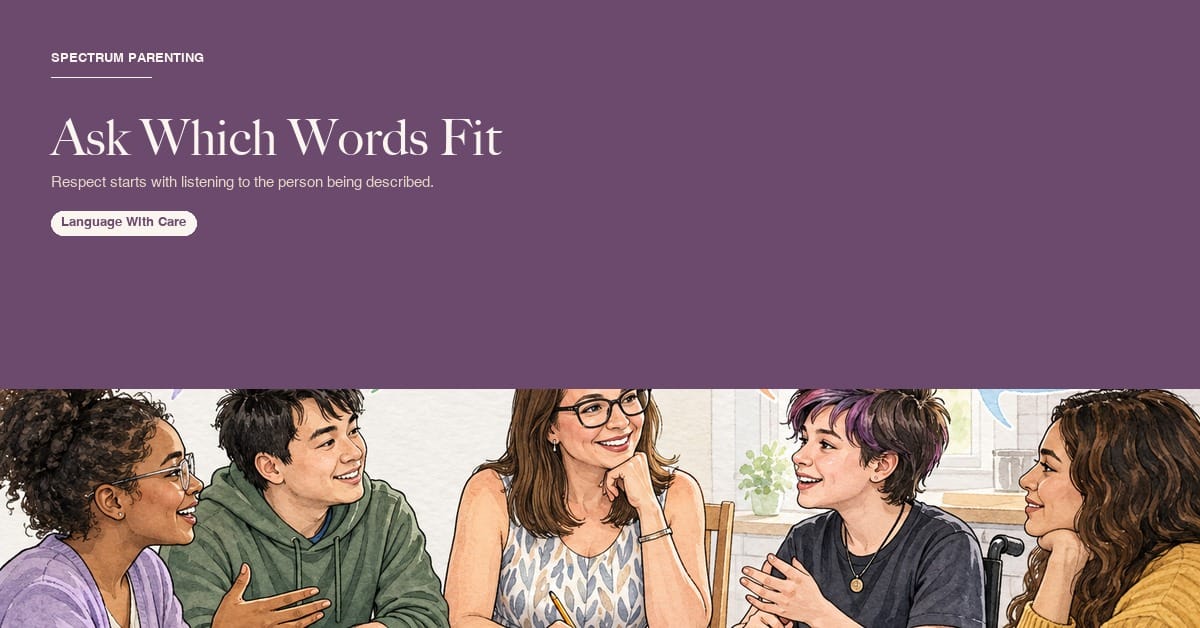
When talking about one person, ask: “Do you prefer autistic, person with autism, on the spectrum, or something else?” Do not ask them to defend the choice. Remember it. Use it in school meetings, medical notes, introductions, and family conversations when they want you to.
Children may not have a settled preference yet or may communicate it without speech. Parents can expose them to respectful language, notice discomfort, avoid shame, and leave room for the child to choose later. A parent’s wording should not permanently overrule an autistic person’s own preference.
Some words cause more harm than this debate
“Nonverbal” is often used broadly, even for someone who communicates with typing, signs, pictures, gestures, or a device. “Nonspeaking” may be more accurate when speech is the missing channel, but individual preference still matters. Describe the communication method instead of treating speech as the only evidence of thought.
Avoid calling an adult a child, praising ordinary behavior as inspirational, or speaking to a companion instead of the autistic person. Slow processing is not lack of understanding. A person may need more time, written information, reduced sensory input, or another way to answer.
“Special needs” remains familiar in parenting and education spaces, but some disabled people prefer “disabled” because the need for access is not shameful or unusual. Again, ask when referring to an individual and follow the community’s stated language when writing for a group.
Functioning labels can hide needs and strengths. “High functioning” may deny support to someone who masks distress, while “low functioning” can erase competence and autonomy. Describe the actual support need: uses AAC, needs help with daily living, speaks fluently, requires supervision near traffic, or needs extra processing time.
Avoid language that presents autistic people as broken, tragic, contagious, burdens, or puzzles to solve. “Suffers from autism” should not be the default. If a person says they are suffering, name what is causing it: pain, exclusion, anxiety, sensory overload, bullying, or lack of support.
What to do in a mixed audience
Organizations should write down a flexible style rule. It can say that the publication defaults to “autistic person,” honors individual preferences in profiles and interviews, avoids functioning labels, and updates language as community guidance changes. That is more useful than silently switching terms from paragraph to paragraph.
Parents can model the same flexibility with schools. If an IEP says “student with autism” but the student prefers “autistic student,” ask the team to use the student’s language where the form allows. More important, make sure the document describes strengths and needs without reducing the child to compliance or deficits.
Language should lead to action
Schools and clinics can audit their forms instead of waiting for a family to object. Intake questions, evaluation reports, goal banks, and automated letters often preserve old wording for years. A small review with autistic people and families can catch language that assumes incompetence, treats every difference as a deficit, or describes compliance as the goal.
Media stories need the same care. Avoid a dramatic before-and-after story in which therapy supposedly reveals the “real” child. Growth, communication, and new skills matter, but the child was always present. Ask whether the headline respects the person who will one day read it.
Family language matters most in private moments, when no advocate or teacher is listening. Children hear how adults describe them on phone calls, at appointments, and across the dinner table. Speak about support needs honestly, but do not turn a hard day into a permanent verdict about who the child is.
When grandparents, teachers, or friends resist updated wording, keep the correction concrete. Explain which term the person prefers and what respectful behavior should follow. The goal is not to win a vocabulary argument. It is to make the autistic person safer, heard, and included.
Listen to patterns in everyday speech too. People sometimes say “everyone is a little autistic,” use autism as an insult, or describe a difficult person as being “on the spectrum” without knowing anything about them. Those comments turn a real disability and identity into shorthand for behavior someone dislikes. Correct the idea plainly and move on.
Parents also deserve room to describe hard support needs without being accused of disrespect. We can talk honestly about dangerous elopement, self-injury, sleep loss, feeding problems, or the need for full-time care while keeping the autistic person’s dignity intact. Be specific about the barrier and the support. Do not make the person into the problem.
In research and news, check who gets quoted. A story about autistic lives should include autistic voices, not only clinicians, organizations, and parents. When a participant cannot use speech, accessible communication and careful consent still matter. “Nothing about us without us” should affect whose knowledge counts, not sit as a slogan at the end.
The right term cannot make an inaccessible classroom accessible. It cannot replace AAC, stop bullying, treat pain, or create a quiet place. Respectful words should travel with respectful decisions: presume competence, offer communication access, explain changes, allow regulation, and include autistic people in decisions about their lives.
It is possible to use identity-first language and still ignore an autistic person. It is also possible to use person-first language with genuine care because that is what the individual requested. The test is whether our listening changes what we do.
For a classroom, article, or group where individual preferences differ, explain the choice briefly. You can use identity-first language because many autistic self-advocates prefer it, mix respectful forms, or follow the organization’s stated community preference. The explanation matters less than whether autistic people had a voice in it.
Correct mistakes without making the autistic person comfort you. “Thank you. I’ll use autistic person” is enough. If someone uses different words for themselves, do not police them with a style guide.
Language changes because people keep telling us what feels accurate. Listening is not walking on eggshells. It is a normal part of treating someone with respect.
I may still get a word wrong. I can also learn, correct it, and keep listening.
A Few of Our Go-To Favorites
Shop the Full StorefrontNothing in our storefront is specific to this guide, so here’s one real favorite from each of our categories instead.

Trekassy 40" Saucer Tree Swing (Sensory Toys)
Our most-used backyard sensory swing, hands down.
$39.99

Skoolzy Peg Board Set (Sensory Learning Toys)
Great for fine motor practice, no screen required.
$16.99


MaryRuth’s Kids Ionic Zinc Drops (Suppliments)
Part of our everyday immune-support routine.
$18.95

Boon Travel Drying Rack (Travel Essential)
Small enough to actually pack, useful every trip.
$12.70

SwimWays Dive and Catch Game (ASD Swimming Gear)
Builds pool confidence without feeling like a lesson.
$19.43
If you’ve already been down this road and found something I didn’t mention here, I’d genuinely like to hear it. You can always reach me through the contact page.
Caren